

40% of new business professionals work weekends during pitches.
The “Great Pitch Poll 2026,” the annual UK survey conducted by research firm Censuswide for British consultancy The Great Pitch Company among agency new business teams, paints the portrait of a growth model (or is it a survival model?) running on the exhaustion of its own people.
Forrester puts the cost of these reviews and the dysfunctional process around them at $12.5 billion a year, borne by agencies and ultimately by their clients. In France, the AACC estimates the average cost of a pitch at €32,000 per agency, while only two pitches out of ten are compensated at all.
This is our industry’s paradox: pitches are the engine of every agency, and they are also one of the reasons its talent walks out the door—the very people tasked with winning those reviews and keeping clients happy over the long haul.
Adland wants off the ship
81% of respondents say they have “seriously considered changing jobs” because of business development pressure. More strikingly, 74% have considered “leaving the advertising or communications industry altogether” for the same reason.
That distinction is worth dwelling on, because it changes everything. Thinking about switching agencies is ordinary dissatisfaction, almost routine in a business where mobility is the norm. Thinking about leaving the profession is something else entirely: a surrender, the verdict of someone who no longer believes another employer will fix the problem. When nearly three-quarters of a professional population gets there, this stops being a local management issue and becomes a business model issue.
Pitching makes people sick, and everyone knows it
70% of the new business professionals surveyed say that they, or someone they know professionally, “had taken sick leave or become ill due to stress caused by pitching” or new business demands.
The number lands harder because it coexists with genuine awareness: 84% agree that positive mental wellbeing is critical to delivering a successful pitch. In other words, the industry fully understands the link between the health of its teams and its commercial performance—it simply has not translated that understanding into how the work gets organized.
70% of ad people have watched someone get sick because of pitching.
Exhibit A: 42% say they are expected to work weekends during pitch periods, “often” and for some “always.” That figure climbs to 51% at agencies whose conversion rate sits between 33% and 66%: the ones losing every other pitch. Sacrificing weekends is a long way from guaranteeing a win.
More demanding clients, shorter deadlines
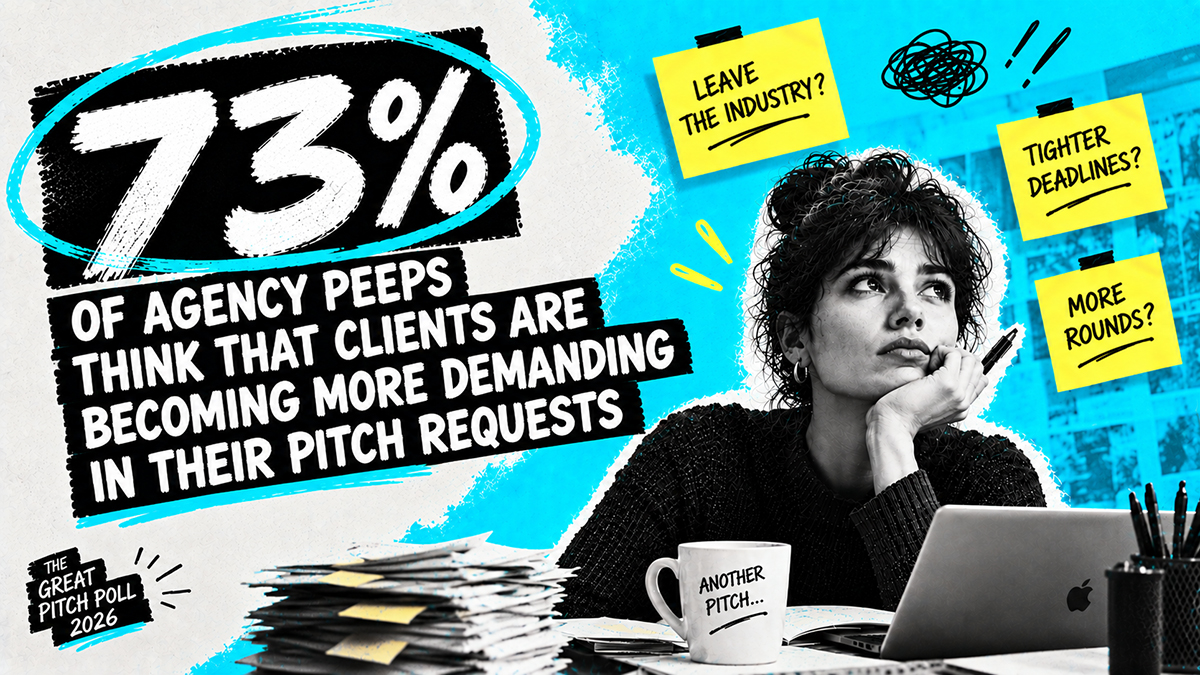
Part of the pressure comes from outside. 73% of respondents believe clients are becoming “more demanding,” even “unreasonable,” in what they ask for in a pitch, and 60% report a rise in short-turnaround assignments, the “we’ll need that recommendation by next week” variety.
Here is the economic knot: a pitch is expensive in human hours, that cost is almost never paid for, and the market keeps asking for more of it. Marcus Brown, Founder of The Great Pitch Company, who has run the survey since 2021, does not mince words: “Agencies cannot continue to rely on the blood, sweat and tears of their people to fuel growth.”
AI is adding to the load, not lifting it
You might hope automation would ease the burden. The opposite is happening. 40% of respondents say “AI is leading to more questions in briefs,” the same share reports “more content” now expected in pitches, and 34% point to shorter turnaround times.
The mechanism is a familiar one, and it shows up everywhere AI takes hold: the productivity gain is not returned to teams as time; it is immediately reinvested in volume and expectation. Production time does not shrink—output grows to fill exactly the same window.
What actually works: learning to say no
The survey is not only a catalogue of failures, and this is its most useful part. Agencies that decline enough opportunities to protect their people report significantly higher levels of employee happiness and far more openness about mental health. Commercial discipline—qualifying, prioritizing, negotiating, walking away—turns out to be the single biggest lever for wellbeing, ahead of any support program.
Exhausted teams are being asked to win pitches they never had time to prepare.
And that is precisely what is missing. 51% of respondents say they are on their own when it comes to managing wellbeing during high-pressure periods: no training, no framework, figure it out. The same goes for operational readiness: 67% get one or two days of rehearsal before a presentation, but almost 20% get half a day or less.
The idea gaining ground: stop at the chemistry meeting
If the problem is the volume of speculative work produced for nothing, the most radical fix is to stop producing it altogether. That is exactly what Mother proposed back in June 2022 with its “Pitch It Forward” initiative: the London agency committed to being appointed straight out of a chemistry meeting, on the strength of a credentials document, its existing client case studies and its fee structure, with no speculative creative recommendation whatsoever.
The argument from Chris Gallery, partner at Mother, fits in a single sentence: “Nine out of 10 times our clients pick agencies from a chemistry meeting or have an instinct of who the right agency would be.” Which means the hundreds of slides produced afterward serve only to ratify a decision already made. TBWA\London, through CEO Larissa Vince, publicly backed the call.
The stunt of the moment: “cheating”
In Seattle, agency Copacino Fujikado has just attacked the problem from the other end with “Agency Cheat Day,” an invitation to marketers to cheat on their current agency—just this once. The agency is giving away four two-week creative sprints, one per quarter, to four Fortune 1000 companies, with zero obligation to continue. The marketer brings a real brief, and two weeks later the agency comes back with five to seven campaign-level ideas. If the client wants to keep going, they pay from that point forward. “We’ve built our reputation on not always being the safe, familiar choice,” says Scott Foreman, CEO of Copacino Fujikado. “If a CMO can see what we do with zero risk and zero cost, the only reason left not to try us is inertia.”
Yes, technically, this is still unpaid speculative work. But where a conventional review pits four to seven agencies against each other, all producing recommendations for free for the same advertiser, on that advertiser’s terms and timeline, “Agency Cheat Day” hands control back to the agency, which chooses on its own to put its expertise on the table, with no direct competition, knowing exactly what it is spending, for how long and why. It is a business investment and a marketing play, not a slow bleed. The difference between having your wallet lifted and buying a round.
What about France?
The survey is British, so the numbers cannot be transposed wholesale. But the underlying picture knows no borders: unpaid reviews, a handful of days to build a full recommendation, understaffed new business teams working under constant pressure. The recent 2026 Barometer of the Attractiveness of Communications Careers offered a troubling French echo: agency professionals rate their own sector lowest of all (6.7 out of 10) and 19% of communications professionals cite workload and stress among the main barriers to the profession’s appeal.
Launched in 2014 and built on greater transparency, accountability and good faith between agencies and advertisers, the La Belle Compétition charter has, unsurprisingly, gone down far better on the agency side. One year after launch, 136 agencies had signed it—against just 13 advertisers. The trade bodies behind the charter are the AACC (Association des Agences-Conseils en Communication), the ADC (Association Design Conseil), the ANAé (Association des Agences de Communication Événementielle), SYNTEC Conseil en Relations Publics, UDECAM (Union des Entreprises de Conseil et Achat Média) and the UDA (Union des Annonceurs).
The message of the Great Pitch Poll to agency leadership is to stop romanticizing pitch pressure. It is not a rite of passage, nor a quirk of the industry. It is an enormous line of cost, paid in unbilled hours, in turnover, in sick leave and in frustration bleeding into outright disengagement.
Methodology: “The Great Pitch Poll 2026” is the annual survey run by The Great Pitch Company and conducted by research firm Censuswide among 134 professionals who have worked at a UK communications agency in the last 12 months, within a new business or marketing team. Media, creative, digital, PR, direct, performance, design and healthcare agencies are all represented.