

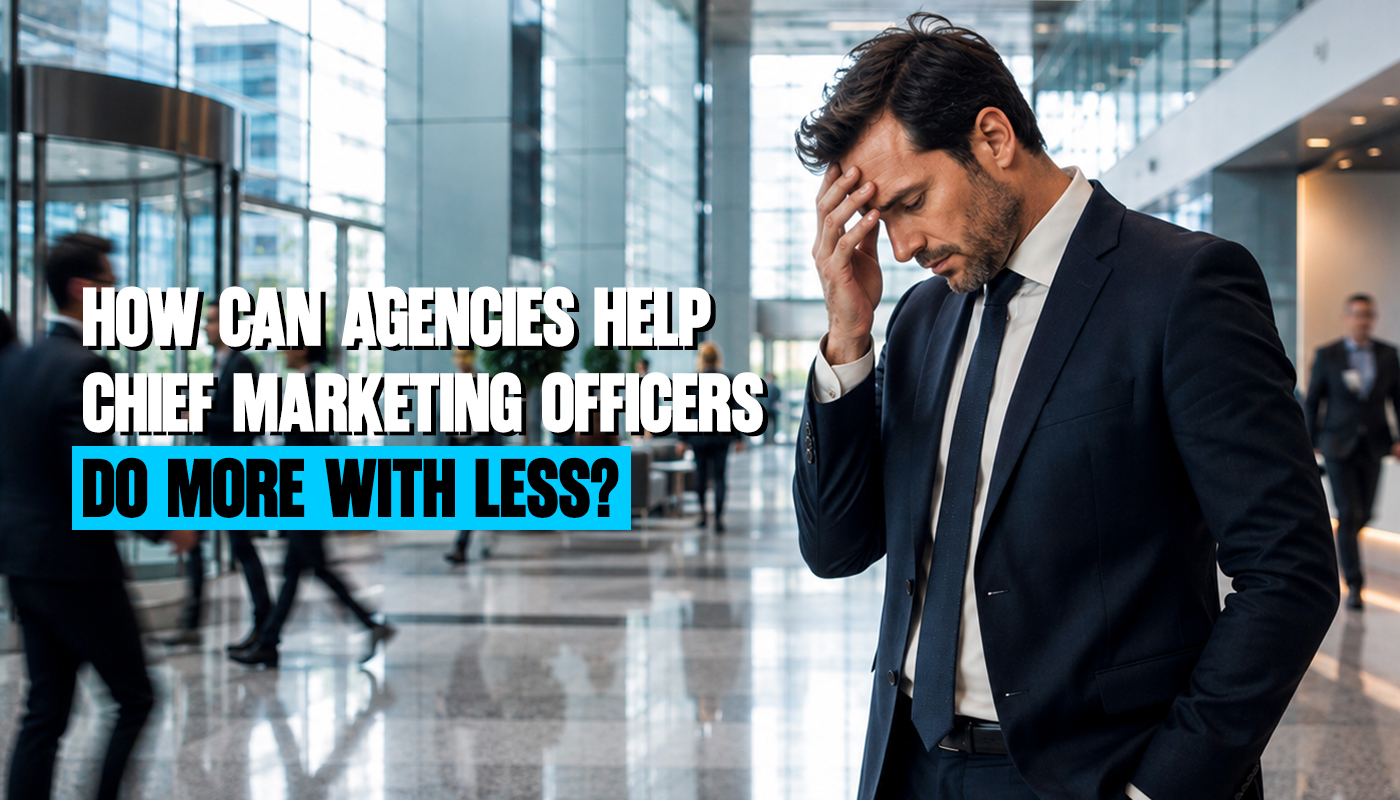
More strategic, more exposed and confronted with emerging trends such as AI, the expectations placed on Chief Communications Officers (CCOs) and Chief Marketing Officers (CMOs) are evolving in 2026 — and are already impacting communications agencies.
Conducted by Comfluence in June 2026 among “105 Chief Communications Officers from French companies, federations, institutions and organizations,” the second edition of the “Annual Barometer of Communications Directors” highlights a function undergoing profound transformation.
While the study focuses on the French market, the breadth of this research, covering 105 organizations, and my experience working with international clients lead me to believe that many of these insights are highly relevant and applicable well beyond France, if not across the communications industry as a whole.
The 6 key concerns and needs of CMOs in 2026
Based on a survey of more than 100 marketing and communications leaders on the client side, these are the six topics that came up most frequently:
- Declining human and financial resources. This is the number-one concern, cited by 41% of Chief Communications Officers and CMOs. With resources under pressure, communication leaders are having to reassess priorities and focus their efforts where they can create the most value.
- Internal cohesion. Maintaining a strong sense of collective purpose is becoming increasingly difficult in organizations operating in a more tense and uncertain environment. Communication plays a key role in keeping employees aligned and maintaining coherence internally.
- Information fragmentation. Chief Communications Officers and CMOs are operating in an increasingly fragmented information environment, where messages circulate across a growing number of channels and audiences. Maintaining consistency and coherence therefore becomes a growing challenge for organizations.
- Distrust. The growing climate of distrust is another major concern for communication leaders. In this context, credibility becomes increasingly important: organizations need to ensure that what they say, what they do and what their stakeholders perceive remain aligned.
- Fake news and disinformation. Fake news is identified by Comfluence as one of the major systemic concerns facing communication leaders. In an environment where information can spread rapidly and challenge an organization’s credibility, this adds another layer of complexity to the communication function.
- Hyper-reactivity and increasingly polarized debates. Communication teams must operate in an environment where debates can become increasingly sensitive and polarized, while organizations are expected to react ever faster. This places greater pressure on communication leaders to anticipate tensions and navigate increasingly unstable public conversations.
Chief Communications Officers are moving closer to the center of decision-making
The growing influence of the Chief Communications Officer within organizations confirms this shift: 77% of communications leaders have direct contact with senior management, and nearly 60% now sit on their company’s executive or management committee.
However, this proximity to senior leadership does not yet translate into full strategic recognition. Only 47% believe that “communications is fully recognized as a strategic function.” This is the paradox highlighted by Comfluence:
The Chief Communications Officer is increasingly present at the top of the organization, but their legitimacy and influence in decision-making remain limited.
In this new role, the CCO is no longer simply responsible for promoting the company. They must navigate sometimes conflicting interests, engage with multiple audiences and help maintain trust in the organization. This is why Comfluence describes the Chief Communications Officer as an “organizational diplomat.”
Growing responsibilities, but resources remain under pressure
This growing influence comes in an increasingly challenging environment. For 41% of Chief Communications Officers and CMOs, the primary concern is the “loss of their ability to act,” whether due to reduced staffing or budgets.
Their concerns now also extend far beyond traditional communications and marketing challenges: internal cohesion, information fragmentation, distrust, fake news, hyper-reactivity and increasingly polarized debates have become systemic concerns.
Chief Communications Officers and CMOs are expected to manage more issues, sometimes with fewer resources, in an environment where companies are expected to respond faster than ever.
For agencies, this raises a straightforward question: how can they deliver greater value when budgets and resources are under pressure?
AI is already changing the role and value of agency work
The other major shift comes from artificial intelligence. More than 70% of Chief Communications Officers say that “AI is already transforming the way they work,” while nearly 80% are increasingly bringing editorial production in-house thanks to these tools. AI therefore enables communications teams to produce more content internally and reduce their reliance on certain executional services.
In other words, as AI makes content production easier, agencies’ ability to understand, advise and anticipate becomes increasingly valuable. For agencies, the question is no longer simply what they can produce for their clients, but what they can bring to the table that CMOs and Chief Communications Officers cannot easily do themselves with AI.
The 5 main takeaways for advertising, communications and marketing agencies
The Comfluence barometer doesn’t just highlight the new challenges facing Chief Communications Officers and Chief Marketing Officers, it also offers valuable insights into what companies can now expect from their agencies:
- Strategy is becoming more valuable. As companies face resource constraints and the rise of AI, they need to make choices and prioritize their investments. Agencies’ ability to understand their clients’ challenges, bring a clear point of view, and help them make better decisions is therefore becoming increasingly important.
- The ability to provide sound judgment is becoming a differentiator. In an environment shaped by information fragmentation, fake news, distrust, and increasingly polarized debates, agencies need to do more than simply create content. They also need to understand the context in which those messages will be received and help CMOs stand out without putting their reputation at risk.
- Agencies need to think beyond their own expertise. The concerns raised by Chief Communications Officers show that the various challenges facing communications are increasingly interconnected. Internal cohesion, reputation, information, executive communications, and digital communications can no longer always be considered separately. For agencies, this means developing a better understanding of how their expertise fits into their clients’ broader communications strategies.
- Understanding clients’ challenges is becoming as important as understanding their brands. Companies are operating in an increasingly complex economic, social, and societal environment. Agencies therefore need to go beyond understanding their clients’ brands, audiences, and competitors to gain a deeper understanding of the internal and external pressures, constraints, and challenges they face.
- Production alone is becoming less of a differentiator. Nearly 80% of Chief Marketing Officers say they are bringing more content production in-house thanks to AI. As certain production tasks become easier to handle internally, agencies can no longer rely solely on their ability to develop concepts and produce content quickly. Their ability to bring innovative ideas, strategic vision, expert advice, and a deeper understanding of their clients’ challenges is becoming increasingly valuable.
A communications function at a turning point: both a threat and an opportunity for agencies
Agencies sometimes think they know better than their clients what their brands need. But if agencies want to anticipate where the market is headed and remain relevant tomorrow, they first need to understand the challenges their clients are actually facing today. This 2026 study suggests that the best partner for CMOs and Chief Communications Officers may no longer be the one that produces the most, but the one that provides the best strategic and business advices.
- The threat is becoming little more than a production vendor in a world where production is getting cheaper and can increasingly be handled in-house.
- The opportunity is precisely the opposite: becoming the partner that can deliver what AI still can’t. Vision, sound judgment, foresight, and a deep understanding of the challenges facing the business.
This kind of research should not be viewed simply as an annual industry report. Regularly listening to clients and understanding their evolving challenges, constraints, and expectations should be a fundamental practice for any agency that wants to remain relevant and future-proof.
What do you think? Are agencies really following their clients’ needs, or are they following their own instincts, ambitions, and convictions? When was the last time your agency asked its clients what their biggest challenges are, and what they truly expect from you?